




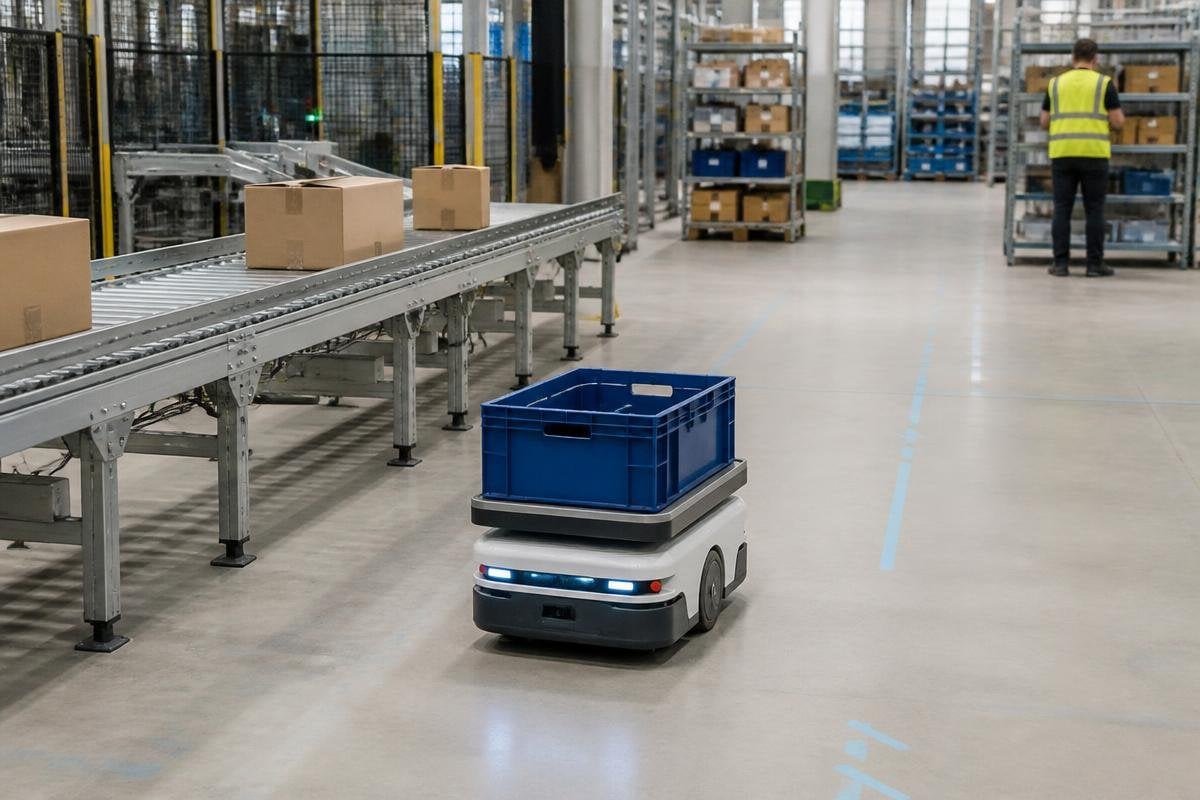
A conveyor locks a route into the building. An autonomous mobile robot (AMR) can change its route in software and carry goods around people, shelves, and temporary work areas.
Quick read
- AMRs suit warehouses where routes, products, or work areas change often
- Conveyors still fit high-volume flows between fixed points
- The real test is the full cost of charging, traffic control, safety, and support
What changes on the floor
A conveyor moves items along a set path. It needs frames, motors, belts, transfers, guards, and floor space from one station to the next. Changing that path can mean moving hardware and stopping nearby work.
An AMR carries a tote, cart, or pallet on its own drive system. Cameras, LiDAR, and other sensors help it locate its position and detect obstacles. Fleet software assigns jobs, chooses routes, and sends another robot when one needs to charge or leaves service.
That changes the work in a useful way. A warehouse can add a new pick area without extending a belt across the floor. A plant can send parts to a different line after a product change, provided the software, maps, and loading points are ready.
The robot still needs a clear task. It must know where to collect the item, where to leave it, and how to confirm that the handoff worked. A person may load a tote badly, a station may be blocked, or a door may stay closed. Those cases need rules and a person who can fix the cause.
Where AMRs fit better
AMRs make the most sense when movement patterns change. They can serve several stations during a shift, move around temporary storage, and support work areas that would be expensive to connect with fixed equipment.
They also suit operations that grow in stages. A company can start with a small fleet, test one route, then add robots as demand rises. That approach reduces the amount of floor equipment installed before the process has settled.
The trade is that each robot needs battery charging, service access, safe traffic rules, and software that can manage the fleet. Fixed conveyors concentrate their drive hardware in one system. An AMR fleet spreads that work across many mobile units.
A conveyor buyer needs more than a robot’s travel speed. The route, payload, charging plan, and site result show whether mobile units can replace a fixed line. Warehouse automation reports from Robot24.com can add those details before the article turns to where fixed conveyors still fit.
Where conveyors still fit
A conveyor remains a strong choice for a stable, high-volume route between known points. Once the path, load size, and station layout stay fixed, a belt can move items without a battery plan or fleet scheduler.
Conveyors can also support a process that needs constant spacing or exact timing. An AMR may wait for a blocked aisle, a slow handoff, or a charging slot. That delay matters when one missed delivery stops a line.
The decision should include more than the purchase price. Count installation, floor changes, charging equipment, software fees, maintenance, safety work, and the cost of changing the layout later.
I’d choose AMRs when route changes are common enough to make fixed hardware a recurring expense.
Limits you need to plan for
AMRs don’t remove material-handling work. They move it into software, site design, and daily fleet care. Someone must keep maps accurate, inspect sensors, manage battery health, and review blocked routes.
Mixed traffic needs care too. People, forklifts, carts, and robots share space, so the site needs marked paths, speed limits, warning lights, and emergency stops. The correct setup depends on the robot, the load, the building, and the safety rules that apply at that site.
Performance can also change with floor condition, lighting, wireless coverage, ramps, door thresholds, and load placement. A route that works in a quiet trial may need more rules when several shifts use the same aisle.
A practical buying check
Use these points before choosing a conveyor or an AMR fleet:
- Map the moves: record each pickup, drop-off, load, distance, and handoff
- Count the changes: list how often products, stations, routes, or volumes change
- Check the floor: measure aisle width, thresholds, ramps, doors, traffic, and Wi-Fi coverage
- Price the support: include charging, spare parts, software, training, safety work, and service
- Run a small trial: test the busiest route and the most common failure case
A fixed conveyor is usually easier to plan when the route will stay fixed for years. An AMR system earns its place when the building and the work keep changing, and the next layout change has a real cost.